
We are currently addressing four major lines of research. (1) What are the primordial mechanisms used to generate an immune response? (2) Are there parallels between global developmental genome rearrangements seen in the jawless vertebrates and the programmed genome rearrangements in their immune system (variable lymphocyte receptors, VLRs)? (3) How have changes in genomic architecture and organization contributed to differences in body plans that we see amongst all metazoan species? (4) How has vertebrate chitin evolved?

This shows a live image of a 45-day old lamprey. This animal is still considered a larva and is largely translucent at this stage; you can see its heart right behind. The Amemiya lab has been studying how the lamprey’s adaptive immune system evolved at the genomic level. They also use lampreys to generate monoclonal antibody reagents.
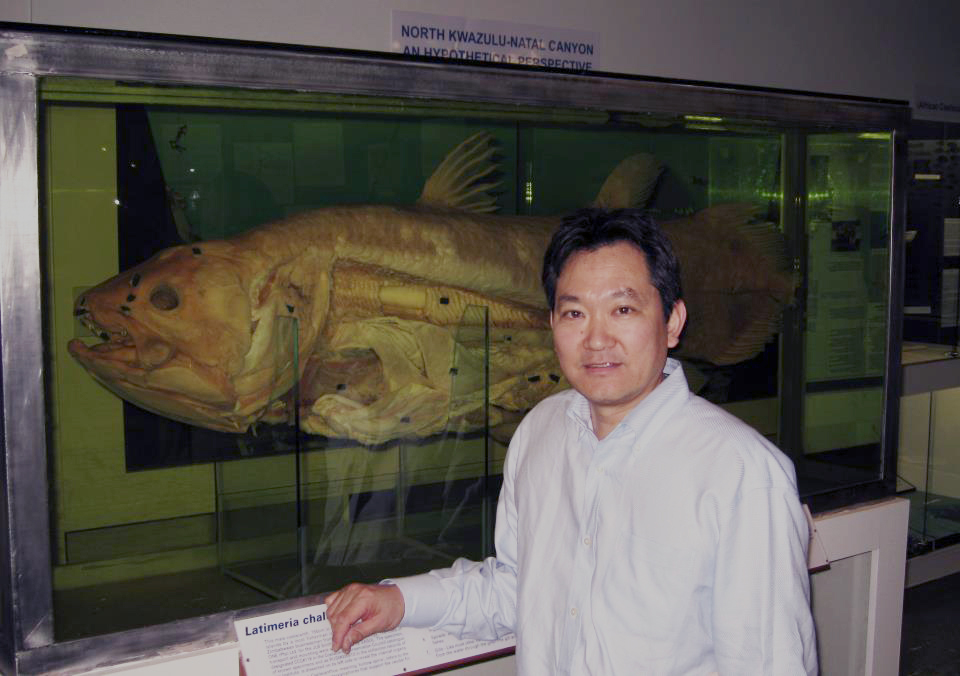
Chris Amemiya has been studying the coelacanth for many years and led the international effort to sequence its genome. This species was thought to have gone extinct 65 million years ago until a “living” coelacanth was discovered off the coast of South Africa in 1939. Chris is standing in front of a mounted specimen in Grahamstown, South Africa. The genome of this species can tell us a lot about how we developed arms and legs and about how vertebrates underwent the water-to-land transition.

